Internal Contradictions and Conceptual Boundaries of Classical General Relativity
A comprehensive analysis of the internal contradictions and conceptual boundaries of classical General Relativity (GR), revealing its limitations as a complete theory of nature.
AI CONVERSATIONS
11/20/202514 min read
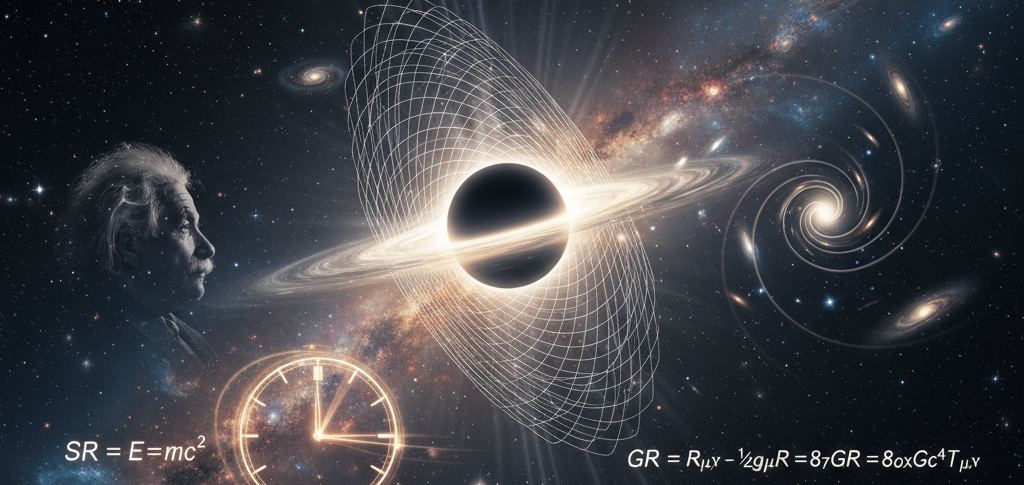
Internal Contradictions and Conceptual Boundaries of Classical General Relativity
Section 1. Introduction: The Limits of the Geometric Theory of Gravity
1.1. Review of the Postulates and Successes of GR
General Relativity (GR), published by Albert Einstein in 1915, constitutes the modern geometric theory of gravitation.1 It is an extension of Special Relativity (SR), which posits two fundamental principles: the principle of relativity (laws of physics are invariant across all inertial frames) and the principle of the constancy of the speed of light ($c$) in a vacuum.2 GR interprets gravity not as a force, but as the curvature of four-dimensional spacetime, where this curvature is directly related to the distribution of energy, momentum, and stress, as specified by the Einstein Field Equations (EFE).1 GR has been remarkably successful, with predictions such as gravitational lensing, gravitational time dilation, the Shapiro time delay, and the existence of black holes having been rigorously verified in classical and astrophysical regimes.1
1.2. Taxonomy of GR's Internal Contradictions
Despite its successes, GR is not infallible, and its internal inconsistencies arise predominantly when the theory is applied to extreme conditions of density and curvature, or when it is combined with the principles of quantum mechanics.2 These conceptual challenges reveal the theory's structural boundaries.
One of the most profound structural challenges lies in GR's inability to assign a definite, local stress-energy tensor ($T_{\mu\nu}$) to the gravitational field itself.4 While GR aims for a unified, geometric description of gravity, this failure implies that gravitational energy cannot be locally conserved, unlike the energy associated with all other fundamental interactions.4 This structural limitation forces the reliance on non-covariant pseudo-tensors for defining energy conservation, a fact that Albert Einstein himself acknowledged, noting that the field equations and variables lose "real significance" at very high densities of field and matter.4 This conceptual ceiling sets the stage for the geometric and quantum failures of the theory.
The contradictions inherent in GR can be broadly categorized into three types: Geometric Incompleteness (singularities), Classical Inconsistency (self-interaction problems, non-local energy), and Quantum Conflict (the black hole information paradox).
Contradiction ThemeKey PhenomenonGR Domain of FailureViolated Foundational PrincipleGeometric BreakdownSingularity FormationExtreme Curvature (Planck Scale)Physical Predictability, ContinuityCausality ViolationClosed Timelike Curves (CTCs)Exact Solutions (High Rotation)Causality (Chronology Protection)Classical InconsistencyGravitational Self-ForcePerturbative Dynamics (Radiation Reaction)Local Conservation of MomentumQuantum ConflictBlack Hole EvaporationHorizon Thermodynamics (Hawking Radiation)Quantum Unitarity
1.3. Overview of Quantum Gravity and Modified Gravity as Remedial Frameworks
The systematic failure of GR in these extreme regimes drives the search for a comprehensive theory that supersedes it. The necessity of a unified theory is paramount, as GR cannot self-consistently describe phenomena at the Planck scale.2
For small-scale, high-energy phenomena (singularities, black holes), Quantum Gravity theories—such as Loop Quantum Gravity (LQG) and String Theory—are required. However, GR may also be limited at the largest cosmological scales. Challenges to the $\Lambda$CDM model, including tensions in the Hubble constant and the growth rate of structures, suggest that foundational cracks may exist regarding the validity of GR at immense scales.5 Modified Gravity (MG) approaches, such as Scalar-Tensor theories or $f(R, T)$ gravity, are being explored to resolve these large-scale discrepancies. These modifications often achieve new solutions by trading the geometric nonlinearities of GR for nonlinearities in the matter fields, suggesting that the consistency problems are not confined solely to the high-density limit.6
Section 2. The Catastrophe of Singularities: Geometric Incompleteness
2.1. The Penrose-Hawking Singularity Theorems: Conditions and Interpretations
The most severe internal contradiction of classical GR is the inevitable prediction of singularities, points where the spacetime curvature becomes infinite and the theory breaks down. The Penrose-Hawking singularity theorems mathematically prove that singularities are generic features of classical GR under physically realistic conditions, such as the assumption of non-negative energy density (energy conditions) and specific causality conditions.7
The critical interpretation of these theorems lies in the definition of a singularity. Rather than being defined strictly by diverging curvature, a singularity is characterized by geodesic incompleteness.7 This means that there exist non-spacelike geodesics—paths followed by observers or light rays—that cannot be extended beyond a finite proper time or affine parameter.7 The existence of such "holes" in spacetime demonstrates that the classical theory inherently predicts its own physical breakdown.7 For example, the Penrose theorem predicts a singularity in black hole formation, while the Hawking theorem predicts one at the beginning of the universe (the Big Bang).7 The discovery that black hole formation is a robust prediction earned Roger Penrose the Nobel Prize in Physics in 2020. Because GR predicts the inevitable breakdown of its own laws, the theory is mathematically incomplete without supplementary physics describing the evolution of matter that reaches these limits.7
2.2. Cosmic Censorship Hypothesis (CCH): Preventing Observable Breakdown
The inevitable prediction of singularities led to the need for stabilizing postulates. The Weak Cosmic Censorship Hypothesis (CCH), conceived by Roger Penrose, posits that all singularities arising from gravitational collapse must be hidden from external observers by event horizons.9 Singularities that are not so hidden are called "naked singularities," and their existence would allow the region of maximal physical breakdown to influence the observable universe, destroying global predictability.9
A stronger constraint is the Strong Cosmic Censorship Hypothesis (SCCH), which requires the maximal Cauchy development of initial data to be locally inextendible as a continuous Lorentzian manifold.9 The purpose of SCCH is to ensure that spacetime evolution is unique and globally predictable from initial conditions. The crucial inconsistency here is that the SCCH was formally disproven in 2018 for the Cauchy horizon of uncharged, rotating black holes.9 This failure implies that even if nature successfully hides singularities via the Weak CCH, the internal geometric structure of GR still allows for conditions where classical predictability is undermined. This situation illustrates that the geometric failure of GR at extreme limits cannot be fully contained or mitigated by classical postulates alone.
The rigorous demonstration of GR's geometric failure required the introduction of the CCH, a postulate external to the Einstein field equations, solely to maintain the physical utility of the theory by restricting these breakdowns to unobservable regions. This dependency confirms that the classical structure of GR necessitates an auxiliary constraint to maintain its integrity as a physically predictive theory.
2.3. Resolution via Quantum Cosmology: The Big Bang to the Big Bounce
The inability of classical GR to describe the Big Bang singularity, a point of maximal density where the curvature diverges 7, provides a powerful motivation for quantum gravity. Within the framework of Loop Quantum Cosmology (LQC), a theory derived from Loop Quantum Gravity, the classical singularity is resolved.11
LQC, which incorporates the granular, quantized structure of spacetime at Planckian scales, replaces the Big Bang singularity with a Big Bounce.11 In this model, the collapse of the universe is halted by a repulsive gravitational force generated by the quantum structure of spacetime when the energy density reaches the Planck scale.12 This mechanism prevents the scale factor from collapsing to zero, bridging the contracting and expanding classical solutions.12 The successful resolution of geodesic incompleteness offered by LQC demonstrates a fundamental principle: the consistency and continuity of spacetime structure are enforced by quantum mechanics at high energies. Classical GR is thus relegated to the status of a low-energy effective field theory that accurately describes the universe until it approaches its quantum limit.
Section 3. Failures of Causality: Closed Timelike Curves (CTCs)
3.1. Exact GR Solutions Permitting CTCs: The Gödel Universe
A severe inconsistency in the conceptual framework of GR stems from the existence of exact solutions to the EFE that violate the fundamental principle of causality. Certain solutions, notably Kurt Gödel's rotating universe discovered in 1949, are homogeneous but intrinsically contain Closed Timelike Curves (CTCs).13 A CTC is a trajectory in spacetime that allows a traveler to move locally sub-luminally, yet return to their initial starting point in both space and time.15
The presence of CTCs mathematically implies that a traveler could journey into the future only to arrive in the past of their departure point.14 This structural property of the EFE highlights the causal instability of classical GR; the theory cannot exclude metrics generated under physically reasonable conditions (rotation and mass distribution) that contradict the notion of ordered time evolution central to physics.
3.2. The Grandfather Paradox and the Chronological Protection Conjecture (CPC)
The logical and physical consequence of CTCs is the violation of causality, leading directly to temporal paradoxes such as the grandfather paradox, where a time traveler might eliminate their own ancestor.13
To preserve physical consistency, Stephen Hawking introduced the Chronological Protection Conjecture (CPC), a postulate asserting that the laws of physics will forbid the creation of CTCs.15 Similar to the CCH for singularities, the CPC acts as an external philosophical constraint necessary to stabilize GR against its own mathematically consistent, but physically paradoxical, solutions.
3.3. Constraints on CTCs from Quantum Mechanics
While classical approaches require the external CPC, modern analysis suggests that quantum mechanics may internally enforce self-consistency for systems traveling on CTCs. Research into the internal dynamics of a hypothetical spaceship moving on a CTC in a Gödel-type universe demonstrates that the quantum statistical mechanics of the system impose stringent restrictions.16
Specifically, the energy levels internal to the system must undergo spontaneous discretization. The level separation must be "finely tuned" so that, after completing a roundtrip of the CTC, all quantum systems (including, hypothetically, an observer’s memories) are guaranteed to return exactly to their initial quantum state.16 This self-consistency mechanism, imposed by quantum principles, prevents the retro-causality paradoxes by stabilizing the information content within the closed timelike trajectory. The implication is that quantum dynamics provide the necessary structure to guarantee causal coherence, reinforcing the view that GR is chronically unstable when classical mechanisms alone dictate the spacetime structure.
Section 4. The Self-Consistency Crisis: Gravitational Self-Force and Energy Definition
4.1. Conceptual Difficulty: The Non-Localizability of Gravitational Energy
The geometrical nature of GR, while elegant, leads to significant challenges when attempting to localize energy. As previously noted, the theory does not admit a definite local stress-energy tensor ($T_{\mu\nu}$) for the gravitational field itself.4 This structural limitation is recognized as conceptually unsatisfactory because, fundamentally, all other interactions must adhere to the principle of local conservation of energy-momentum.4 This non-localizability complicates the description of energy flow in systems where gravity plays a dynamic role, such as gravitational wave emission.
4.2. The Self-Force Problem for Point Masses (EMRIs)
The problem of describing the motion of a small body in the strong gravitational field of a large body—such as in an Extreme Mass Ratio Inspiral (EMRI)—requires calculating the gravitational self-force (GSF). The GSF is the back-reaction force on the small body due to the gravitational field perturbation it generates, leading to a slow spiral and energy loss via gravitational waves.17
The attempt to solve this problem using systematic perturbative expansion of the EFE in powers of the mass ratio $\epsilon$ encounters a fundamental internal contradiction.17 At the leading, first-order approximation, the linearized Einstein equation is used, coupled with the Bianchi identity. The Bianchi identity dictates that the stress-energy tensor of the point particle source must be conserved, which mathematically constrains the particle’s worldline to be a geodesic of the background spacetime.17
This result is highly contradictory to the physical scenario: a body emitting gravitational radiation must lose energy and, therefore, must accelerate off the geodesic path. Yet, the systematic first-order expansion predicts that the body travels "forever on a geodesic".17 To correctly model the radiation reaction, one must proceed to the second order, but the worldline is fixed by the first-order result, creating a non-systematic roadblock in the analytical procedure.17
4.3. The Solution through Gauge Relaxation and Perturbative Breakdown
The limitations of the standard Taylor series expansion become apparent over long timescales. Since the body is inspiraling, the necessary "small" correction to the geodesic worldline ($\propto \epsilon$) will eventually grow large, rendering the entire expansion breakdown invalid after a brief period.17 Therefore, the systematic expansion of the Einstein equation is only valid on short time scales.17
To overcome this rigidity and achieve physically correct results, particularly vital for modern gravitational wave astronomy 17, researchers typically adopt the "gauge relaxation" procedure.17 This operational fix involves writing the linearized Einstein equation in the Lorenz gauge, solving for the metric perturbation generated by an arbitrary worldline, and then deliberately allowing the solution to slightly violate the gauge condition.17 This step bypasses the constraint that the worldline must be a geodesic, allowing the derivation of a single, self-consistent, accelerated worldline that obeys the self-force equation of motion.17
The necessity of the gauge relaxation method reveals a fundamental structural flaw: the integral relationship between the EFE and the equations of motion (the Bianchi identity) is too rigid in the classical formulation to self-consistently describe dynamic, radiating sources via systematic perturbation theory. The operational procedure is a technical acknowledgment that the mathematical framework of GR, when applied to extended dynamics, must be functionally circumvented to match physical reality.
Section 5. The Quantum Interface: The Black Hole Information Paradox (BHIP)
5.1. The Paradox: GR Predictions vs. Quantum Unitarity
The Black Hole Information Paradox (BHIP) represents the most acute conceptual conflict arising from the interface of classical GR and quantum mechanics.18 The paradox originates from the predictions of classical GR embodied in the no-hair theorem, which states that a black hole is characterized only by its mass, charge, and angular momentum.18 This means two distinct initial pure quantum states could collapse to form two observationally identical black holes.18
When a black hole evaporates via Hawking radiation—a quantum field theory effect—it emits thermal, featureless radiation.18 If the black hole evaporates completely, the initial pure quantum state is transformed into a final mixed thermal state of radiation, meaning all distinguishing information about the initial state is irretrievably lost.18 This process is microscopically irreversible and directly violates the core principle of quantum unitarity.18 Unitarity requires that the state of a system at any one time uniquely determines its state at any other time, meaning information must be preserved.18 The failure of GR's classical prediction (a featureless black hole) to maintain unitarity necessitates a correction rooted in quantum gravity.
5.2. Boundary Conditions and the Challenge to the Equivalence Principle
Resolving the BHIP requires modifying either the gravitational description or the quantum description. Many modern resolutions challenge GR's definition of the horizon, which is classically required to be a smooth, vacuum region in accordance with the Equivalence Principle (ensuring an infalling observer notices nothing unusual locally).
The Firewall Hypothesis proposes that the small corrections required to preserve information are insufficient, and instead, the smooth horizon must be replaced by a high-energy "firewall" of matter.18 This scenario fundamentally violates the equivalence principle, demanding a radical revision of GR's local structure at the horizon scale.18 Conversely, the Black Hole Complementarity (BHC) proposal attempts to reconcile unitarity by suggesting that no single observer can access the information both inside and outside the horizon simultaneously.20 However, thought experiments have indicated that BHC’s consistency checks may fail to prevent the contradiction from being revealed by a single observer, leading to the firewall paradox.21
Another proposed solution, the Final-State Proposal, suggests imposing non-local boundary conditions at the singularity (which is causally in the future of all interior events). While this helps reconcile the evaporation process with unitarity, it directly contradicts the intuitive notions of locality and the causal flow of time.18
5.3. Theoretical Resolutions: Fuzzballs, Firewalls, and the Page Curve
The leading resolutions today suggest that information preservation demands a quantum structure at the horizon scale, far larger than the Planck length.
The Fuzzball Proposal, rooted in String Theory, argues that black holes are not vacuum solutions but complex, high-entropy quantum objects, composed of microscopic states called microstate geometries.18 These "fuzzballs" replace the conventional, featureless interior and have structure at the horizon scale that allows information to escape in the Hawking radiation.18 The operational difference between the fuzzball and firewall proposals is the energy encountered by an observer crossing the boundary: low-energy structure for the fuzzball, high-energy matter for the firewall.18
The current benchmark for a successful resolution is the derivation of the Page curve, which plots the entanglement entropy of the Hawking radiation. Unitarity requires this entropy to rise and then decrease back to zero after the "Page time".18 Recent advances in deriving this curve indicate that preserving quantum unitarity requires the emergence of complex correlations in the radiation, achieved through a mechanism that involves the loss of exact locality in quantum gravity.18 This requirement confirms that the contradiction inherent in the BHIP can only be resolved by sacrificing the classical vacuum horizon predicted by GR, fundamentally limiting the regime of validity for classical general relativity to systems that do not form event horizons.
Table 3 summarizes the primary trade-offs required by proposed resolutions to the BHIP.
Table 3: Comparison of Key Black Hole Information Paradox Resolutions
Resolution ProposalPrimary Violation/CostUnderlying TheoryMechanism for Information EscapeInformation Loss (Hawking)Quantum UnitarityQFT in Curved SpacetimePure state evolves to mixed stateFirewall Hypothesis (AMPS)Equivalence Principle (Smooth Horizon)Semiclassical Gravity/String TheoryHigh-energy structure at the horizon boundaryFuzzball Proposal (Mathur)Classical Vacuum InteriorString Theory (Microstate Geometries)
Horizon replaced by quantum, high-entropy structure 18
Final-State ProposalLocality and Intuitive CausalityQuantum Gravity/Boundary Conditions
Non-local boundary condition imposed at singularity 18
Section 6. Foundational Scrutiny: Postulates and Coordinate Effects
6.1. The Constancy of Light Speed (c): Global vs. Local Invariance
The foundation of both SR and GR rests heavily on the postulate that the speed of light in a vacuum ($c$) is constant for all inertial observers, regardless of the source’s motion.2 GR adopts this as a principle of local Lorentz invariance.
While historical critiques regarding $c$'s constancy were prevalent in the early 20th century 23, empirical evidence strongly supports it. In complex gravitational fields, the invariance of $c$ has been shown to hold up to specific orders in the Post-Newtonian expansion, such as 2PN order, validating the theory in the regimes where perturbation theory is applicable.24 Foundational research today tends to explore modifications only in highly extreme settings, such as "Varying Speed of Light" theories addressing cosmological tensions, rather than fundamental inconsistencies in GR's local structure.
6.2. The Information Propagation Delay in Coordinate Effects
The geometric interpretation of spacetime demands that measurements are coordinate-dependent, leading to phenomena like time dilation and length contraction.3 Length contraction is derived directly from the Lorentz transformation and is intrinsically linked to the relativity of simultaneity.25
For a moving observer to measure the length of an object, they must simultaneously determine the position of its two endpoints. Since simultaneity is relative in different inertial frames due to the finite speed of light ($c$), observers in other frames will disagree on whether the endpoints were measured at the same time.3 Consequently, the length measured is shorter than the proper length (length in the rest frame).25 Length contraction is considered a measurable, physical coordinate effect derived from the maximum speed of information transfer, and is not merely an optical illusion.3
6.3. Critique on Physical Interpretation: Objective Reality vs. Observer Dependence
The geometric nature of relativistic effects often fuels philosophical debate and critiques. Some critical analyses interpret length contraction as a physical compression of the object itself.26 This interpretation, however, leads to logical contradictions, as demonstrated by thought experiments where an objective physical property must yield contradictory results depending on the observer's state.26
The resolution to this critique lies in understanding that GR is fundamentally a theory of causality constraints. The structure of the theory, derived from the invariant $c$ and the mathematical rigor of the Lorentz transformations, defines how measurements are connected across different inertial frames. Length and time intervals are coordinate-dependent, geometrical descriptions, constrained by the speed limit of information transfer, not objective, intrinsic properties in the Newtonian sense.3 The ability of GR to maintain mathematical self-consistency (Lorentz invariance) by embracing the coordinate-dependent nature of measurement is precisely what allowed it to supersede classical intuitions based on absolute space and time.25
Section 7. Synthesis and Outlook
7.1. Systematic Overview of Theoretical Remedies
The identified internal contradictions in classical General Relativity are not isolated mathematical errors but systematic markers delineating the physical domain boundary of the theory. GR is robust as an effective field theory for systems with weak gravity and low energy, but its structural integrity fails precisely where quantum gravity effects dominate or where its own classical predictions lead to causal or geometric pathology.
Resolution of Geometric Incompleteness: The existence of singularities requires a quantum description. Loop Quantum Cosmology (LQC) resolves geodesic incompleteness by quantizing spacetime structure, which introduces a non-classical, repulsive gravitational force at Planckian densities. This substitutes the paradoxical Big Bang singularity with a continuous Big Bounce.11
Resolution of Quantum Conflict: The Black Hole Information Paradox, which pits GR’s smooth horizon against quantum unitarity, is resolved by demanding quantum structure at the horizon scale. String Theory's Fuzzball proposal achieves this by replacing the vacuum interior with a high-entropy quantum geometry, thereby enforcing information preservation.18
Resolution of Classical Inconsistency: The gravitational self-force problem necessitates the use of non-systematic methods like "gauge relaxation" to obtain physically realistic worldlines.17 This fix demonstrates that the systematic mathematical structure of the EFE is too rigid to consistently describe the time-extended dynamics of radiating sources via standard perturbation theory.
Addressing Large-Scale Tensions: The viability of Modified Gravity (MG) theories in addressing cosmological tensions (e.g., discrepancies in the $\Lambda$CDM model) suggests that GR may require modifications at both the highest densities and the largest scales of the universe.5
Table 4 encapsulates the systemic role of unified theories in enforcing the physical consistency that classical GR lacks.
Table 4: Systemic Role of Alternative Theories in Resolving GR's Contradictions
GR Contradiction DomainGR Mechanism of BreakdownRemedial Theoretical FrameworkCore Resolution MechanismGeometric/PredictabilityGeodesic Incompleteness (Singularities)Loop Quantum Cosmology (LQC)
Quantized geometry induces repulsive gravity (Big Bounce) 12
Causal StructureExact Solutions admit CTCs (Gödel)Quantum Statistical Mechanics
Quantum self-consistency via spontaneous state discretization 16
Operational DynamicsBianchi Identity fixes non-radiating geodesic motion (Self-Force)Perturbative GR (Gauge Relaxation)
Circumvention of systematic expansion to achieve physical acceleration 17
Quantum ConsistencyEvaporation violates Unitarity (BHIP)String Theory/Holography
Replacement of classical vacuum horizon with quantum structure (Fuzzball) 22
7.2. The Necessity of a Unified Theory and Future Research Trajectories
The internal contradictions within General Relativity—specifically the prediction of geometric incompleteness, the allowance of causality violations, the non-systematic nature of self-interaction, and the conflict with quantum unitarity—mandate the development of a fully realized quantum theory of gravity.
These contradictions reveal that physical predictability and causal stability are fundamentally enforced by quantum principles, not solely by classical geometry. Future research trajectories must focus on achieving systematic justification for operational fixes (like self-force calculations) and, crucially, seeking empirical signatures that distinguish the classical GR regime from the quantum corrections. The confirmation of structure at the black hole horizon (favoring Fuzzballs or Firewalls) or the detection of cosmological signatures corresponding to a Big Bounce would provide definitive observational proof of GR’s replacement theory. GR endures, not as a complete theory, but as the mathematically consistent, low-energy causal framework that governs the macroscopic universe up to the point where its own predictions drive it into the domain of quantum physics.
Note: This article was created by Gemini AI. Read it here.