Beyond Material Abundance: Why the West's Techno-Utopian Vision Cannot Solve the Crisis of Meaning
Elon Musk's AI utopia promises material abundance but lacks answers to meaning and identity. Bharat's Sankhya-Yoga framework offers what the West cannot: a complete civilizational solution.
AI CONVERSATIONS
12/1/20259 min read
Introduction: The Question of Questions
Ten years ago, a document circulated among knowledge seekers that would crystallize an essential truth about human learning: "Don't fall for the question. Fall for the answer." The "Best of Quora 2010-2012" compilation revealed something profound—that the value of discourse lies not in perfectly crafted questions, but in answers so rich they retroactively justify even poorly formed queries.
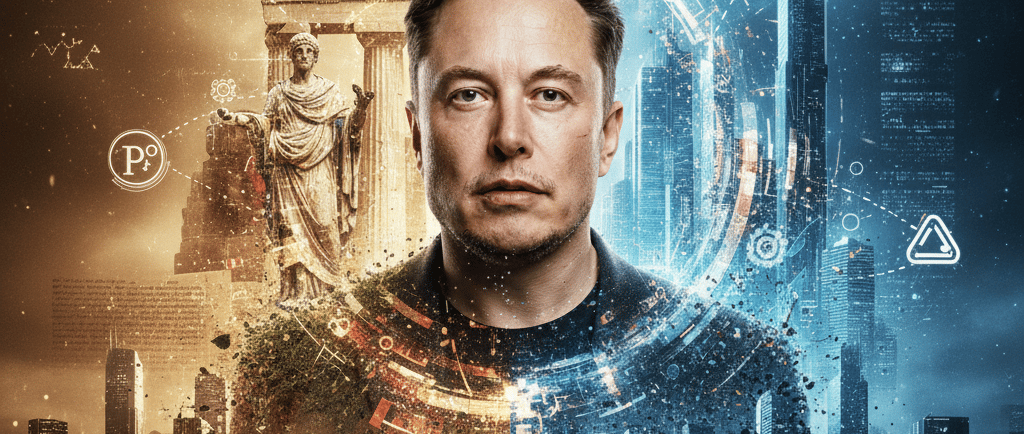
This principle illuminates a deeper civilizational divide. The West, embodied in figures like Elon Musk, remains trapped at the question level: "What is the meaning of life?" "Are we in a simulation?" "How do we expand consciousness?" Meanwhile, Bharat operates at the answer level, having resolved these fundamental queries millennia ago through the Sankhya-Yoga philosophical framework.
This is not mere cultural comparison. It reveals why Western techno-utopianism—despite promises of Universal High Income, AI abundance, and material post-scarcity—cannot solve the crisis that has been deepening for decades, a crisis I explored through the prophetic film "Waking Life" and its twenty-year-old diagnosis of Western philosophical dissolution.
Part I: The Answer-Centric Paradigm
The Quora Principle: When Answers Elevate Questions
The early Quora platform (2010-2012) succeeded not because users asked brilliant questions, but because expert answers transformed trivial prompts into profound knowledge artifacts. Consider:
Question: "What does it feel like to murder someone?"
Value: An unvarnished psychological narrative from an inmate, creating a rare document of the human psyche under extreme duress.Question: "Is wrestling fake?"
Value: An insider's detailed explanation transforming a simple query into a business case study on performance art, physical risk, and kayfabe.Question: "What distinguishes the top 1% of product managers?"
Value: A founder's tactical masterclass on executive decision-making, far exceeding the generic career advice the question seemed to request.
The pattern is clear: the answer makes the question meaningful, even when the question is poorly formed. This occurs because seekers often don't know what to ask—they're searching for "cracks in the wall of ignorance," and expert answers provide those openings while illuminating surrounding territory.
This is fundamentally how knowledge transmission works in guru-shishya traditions: the student asks from ignorance, the guru's answer contains the better question the student couldn't formulate.
Musk's Question Problem
Elon Musk exemplifies Western civilization's confinement to the question level. In his conversation with Nikhil Kamath, Musk references Hitchhiker's Guide to the Galaxy: "The universe is the answer, but we don't know the right questions to ask." His stated mission is to "expand the scope and scale of human consciousness" so humanity can collectively discover those questions.
This sounds philosophically sophisticated, but reveals a critical limitation: Musk doesn't possess the framework to answer his own questions. His simulation hypothesis, his concerns about consciousness, his fears of population collapse—these are symptoms of what I've called the West's identity crisis, a crisis that no amount of technological advancement can resolve.
Consider his logic for the simulation hypothesis:
Video game graphics evolved from Pong to photorealism in 50 years
If this trend continues, indistinguishable simulations will eventually exist
If there's one base reality and billions of simulations, we're statistically likely in a simulation
This is probabilistic reasoning applied to an ontological question. It's sophisticated questioning but provides no actionable answer about the nature of consciousness, the purpose of existence, or how to live well. It's the epitome of Western philosophy post-Enlightenment: brilliant at analysis, impotent at synthesis.
Part II: Bharat's Answer—The Sankhya-Yoga Framework
The Definitive Solution to Identity
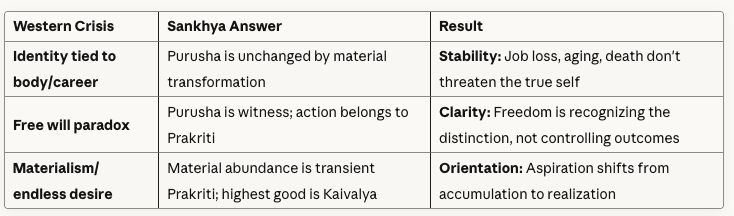
While Western materialism struggles with the "hard problem of consciousness," Sankhya philosophy resolved the identity crisis definitively over two millennia ago through a precise ontological distinction:
Purusha (Consciousness) is eternally distinct from Prakriti (Matter/Nature).
This isn't mere metaphysics—it's a practical solution with concrete civilizational implications:
This provides what Musk's Universal High Income cannot: psychological orientation independent of material circumstances.
Yoga and Tantra: Implementation Systems
Sankhya provides the theoretical answer. Yoga and Tantra provide the methodology:
Patanjali's Ashtanga Yoga: A structured system to bring the mind (chitta) under control, allowing Purusha to rest in its own nature. This directly combats the psychological fragmentation and existential anxiety that characterize modern Western life.
Tantra (as philosophical system): Engages with the material world (Prakriti) not as illusion to shun, but as path to realization, integrating ritual, art, and embodied experience into spiritual practice.
Together, these create a complete civilizational operating system that the West lacks.
Part III: The Materialist Vision's Fatal Flaw
Musk's Post-Scarcity Promise
In the Kamath conversation, Musk outlines a technologically deterministic vision:
Timeline: Within 10-20 years, AI and robotics make work optional
Economic Shift: From "Universal Basic Income" to "Universal High Income" as goods become virtually free
Purpose Solution: Freed from necessity, people pursue "hobbies, learn new skills, or focus on family"
Debt Solution: Massive AI/robotic productivity triggers deflation, neutralizing debt burdens
This vision has surface appeal but contains three critical failures:
1. The Meritocracy Collapse
The Problem: Money acts as the reward system fueling meritocracy. Remove it, and you remove the incentive gradient for difficult, necessary, or undesirable tasks.
Musk implicitly recognizes this, suggesting a shift from material wealth to social capital (status, recognition, access to exclusive experiences). But this creates new problems:
Who assigns status? In a market economy, status emerges from decentralized value judgments. In Musk's vision, status must be assigned by those controlling AI/automation—creating a new form of centralized control more opaque than money.
Essential but unglamorous work: Garbage collection, infrastructure maintenance, elder care—these don't generate status. How are they incentivized? Compulsion? Rotation? This reintroduces the coercion that UHI supposedly eliminates.
Historical parallel: The USSR didn't fail because of abundance (as Musk's vision promises), but because central planning couldn't allocate scarce resources without price signals. Musk's vision faces the Psychological Calculation Problem—how to provide purpose and incentivize high-value human effort without material rewards or clear assignment mechanisms.
2. The Purpose Vacuum
Research in sociology and psychology consistently shows that work provides more than income—it supplies identity, social status, structure, and a sense of contribution. These fulfill Maslow's higher needs: belonging, esteem, and self-actualization.
Musk's assumption that people will naturally pursue meaningful activities when freed from necessity ignores human psychological reality. Studies of lottery winners, the idle rich, and early retirees consistently show that unconditional material comfort without purpose leads to depression, substance abuse, and social isolation.
As I explored in my analysis of "Waking Life," the West already suffers from meaning dissolution despite unprecedented material wealth. UHI would accelerate this crisis, not solve it.
3. The Control Consolidation
If UHI is distributed by those who control AI and automation infrastructure—inevitably a small technological elite—they possess ultimate leverage over the population. The meritocracy shifts from being controlled by decentralized market signals to being controlled by centralized gatekeepers.
This is oligarchic post-scarcity: freedom from want, but dependence on AI priesthood for both material subsistence and social status. The consolidation of power would be total and potentially irreversible.
Part IV: The Indian Civilizational Alternative
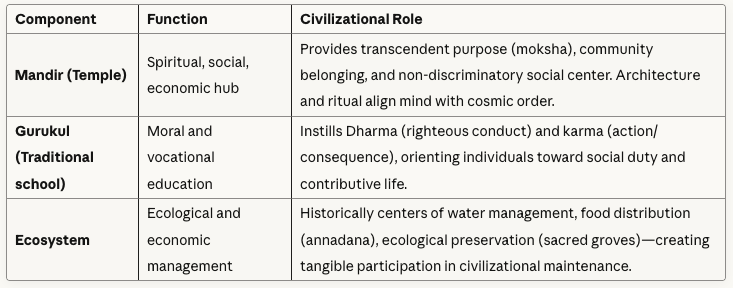
The Mandir/Gurukul Ecosystem
Contrast Musk's vision with the traditional Bharatiya system—a decentralized, culturally embedded infrastructure for psychological orientation and civilizational continuity:
This system explicitly addresses what Musk's UHI lacks: a decentralized cultural framework that defines purpose outside economic production.
The Sanyasi: Systemic Proof of Concept
The figure of the Sanyasi demonstrates the system's philosophical completion. A Sanyasi works for societal betterment without material gain—not as sacrifice, but as natural expression of realized identity.
The logic:
The Sanyasi has realized that Purusha (true self) is separate from Prakriti (material realm including ego and reward systems)
Since the true self neither gains nor loses in material transactions, action becomes non-attached (Nishkama Karma)
Service (Seva) flows from compassion and duty (Dharma), not calculation
The Sanyasi is not a moral outlier—they are the logical endpoint of solving the identity problem. They provide a living model of purpose independent of material incentives, reinforcing the entire moral framework.
Western contrast: Monks exist in Christianity, but their renunciation is theological (for God/salvation) not ontological (as realization of true self). The self is sacrificed for external authority, not realized as eternally free. This makes Western renunciation inherently unstable without strong institutional support.
Rashtra vs. Rajya: Cultural Unity Beyond Political Boundaries
Bharat maintained civilizational coherence for millennia despite political fragmentation because unity was cultural, not merely political:
Rashtra (Nation): Cultural consciousness and spiritual geography, bound by shared sacred space, philosophy, and Dharma
Rajya (Kingdom): Political sovereignty and temporal boundary, bound by law and coercion
The mechanisms maintaining Rashtra unity:
Spiritual Geography: The concept of Bharatavarsha as sacred land (punya-bhumi) from Himalayas to Setu, with pilgrimage networks (tirtha yatra) physically connecting devotees across regions
Uniform Philosophical Code: Pan-Indian frameworks like Sankhya-Yoga and ethical structures like Dharma, with standardized life-cycle rituals (samskaras) ensuring shared psychological grammar
Shared Epics: The Ramayana and Mahabharata as primary vehicles for teaching Dharma and historical context, creating collective consciousness transcending local dialects
This demonstrates that culture, philosophy, and geography can be more resilient unifying forces than political boundaries—a lesson the West, obsessed with nation-state models, cannot comprehend.
Part V: The Linguistic Dimension
Sanskrit's Structural Superiority
Musk notes that English's rich vocabulary enables expression. True—but Sanskrit's superiority lies not in dictionary size but in generative capacity.
1. Dhatus (Verbal Roots): Approximately 2,000 fundamental roots spawn precise derivatives through systematic prefixes and suffixes. Example: The root jñā (to know) generates:
Jñāna (knowledge)
Vijñāna (specialized knowledge/science)
Prajñā (wisdom/insight)
Ajñāna (ignorance)
English requires unrelated words for these distinct concepts.
2. Samāsa (Compounding): Single words represent complex nested ideas. Satchitānanda (existence-consciousness-bliss) condenses an entire philosophical framework into three syllables.
3. Pāṇini's Aṣṭādhyāyī: The grammatical system codified ~5th century BCE is so algorithmic that linguists and computer scientists consider it proto-computational—ideal for both philosophical precision and potentially AI processing.
This structural perfection allowed Sanskrit to become not just a language that describes philosophy, but one engineered by philosophy for maximum conceptual clarity.
Part VI: The Crisis Continuity
An Old Crisis Without Answer
As I documented in "Waking Life and the West's Deepening Crisis," Richard Linklater's 2001 film diagnosed a philosophical dissolution that has only accelerated. The characters in that film wander through phenomenological anxieties, identity fragmentation, and meaning collapse—symptoms of a civilization that destroyed its own foundations.
Musk's technological utopianism is the latest iteration of the same failed pattern: attempting to solve ontological problems with material solutions. From the Enlightenment's "reason will save us" to the 20th century's "economic growth will save us" to today's "AI will save us"—the West keeps applying better tools to the wrong problem.
They discuss ethics but lack foundational theory. Without ontological clarity about the self, Western ethics remains superficial:
Utilitarianism: Maximizing aggregate well-being (but for whom? the body? ego? consciousness?)
Contractarianism: Rules for self-interested agents (but what is the self that has interests?)
Virtue ethics: Character development (but toward what end? for what self?)
These systems work pragmatically within material contexts but collapse when asked: "Why be good when material comfort is guaranteed?" Without Purusha-Prakriti distinction, there's no stable answer.
Part VII: Synthesis and Implications
The Complete Civilizational Model
A sustainable post-scarcity future requires:
Ontological Foundation: Clear definition of self beyond body/ego (Purusha-Prakriti)
Psychological Infrastructure: Decentralized systems for purpose generation (Mandir/Gurukul or equivalent)
Cultural Continuity Mechanisms: Practices that survive political change (samskaras, tirtha yatra, shared narratives)
Ethical Framework: Derived from ontology, not utility or contract (Dharma from realized identity)
The West attempts (1) material abundance without (2-4), risking either:
Social collapse from purposeless masses
Authoritarian consolidation by AI-controlling oligarchy
For India: The Path Forward
Bharat possesses the answer framework but faces implementation challenges in modernity:
Strengths to preserve:
Philosophical clarity on identity (Sankhya-Yoga)
Decentralized cultural infrastructure (though weakened)
Living traditions of purposeful renunciation (Sanyasa)
Sanskrit's generative philosophical language
Challenges to address:
Erosion of Gurukul-style moral education
Commercialization of temple spaces reducing spiritual function
Colonial inheritance of Western materialist frameworks in education
Brain drain of those who could revitalize traditional knowledge systems
The opportunity: As the West's crisis deepens, Bharat can demonstrate that civilizational stability requires answering, not just asking, the fundamental questions.
For the West: The Requirement
The West cannot simply adopt Indian philosophy—transplanting ontological frameworks across civilizations is generationally difficult. But it must recognize:
Material abundance without meaning creates instability, not utopia
Purpose cannot be algorithmically assigned by AI oligarchs
Identity must be grounded in something beyond narrative and body
Decentralized cultural infrastructure is more resilient than centralized control
This might require rediscovering and reinterpreting Western contemplative traditions (Christian mysticism, Neoplatonism, Stoicism) with the rigor that Sankhya applies—moving from theological to ontological foundations.
Conclusion: The Answer, Not the Question
Elon Musk asks: "How do we expand consciousness to ask better questions?"
Sankhya answers: "Consciousness is already complete (Purusha). The question is wrong. The task is realization, not expansion."
The early Quora taught us that valuable answers transform bad questions into profound knowledge. Musk's vision—despite its technological sophistication—remains trapped at the question level, unable to provide the psychological orientation and purpose infrastructure that civilization requires.
Bharat offers not just alternative answers, but a complete answer framework millennia in development. As the Western techno-materialist project accelerates toward its logical conclusion—material abundance without meaning—the relevance of this framework becomes undeniable.
The crisis documented in "Waking Life" twenty years ago was philosophical. The crisis Musk attempts to solve today is technological. But the actual crisis is civilizational: the inability to answer the question "What is the self?" with clarity sufficient to ground purpose, ethics, and communal life.
That answer exists. It has always existed. It simply requires recognition that the Quora principle applies at civilizational scale:
Don't fall for the question. Fall for the answer.